

If you’re looking for dental implants Clairemont residents can reach without a long drive, you’ll find them close by in San Diego’s Mission Bay area. At Azara Dentistry, we want each visit with us to feel calmer than the dental appointments you may remember. Our appointments are unhurried, so you have time to ask questions, share any worries, and hear us explain each step before anything starts. Replacing a tooth is a big decision. It affects how you chew and speak, and how comfortable you feel smiling at work. Dr. Rocio Zaragoza leads our implant care for patients who come to us from Clairemont and the neighborhoods around Mission Bay. Before you sit in the chair for the first time, it helps to know who will be guiding your care.
Dental Implants Clairemont

Meet the Dr.
Dr. Rocio Zaragoza focuses on restoring how your teeth work and feel, and she starts every case by listening to what you want from treatment. When you come to Azara Dentistry for dental implants, she explains what she sees in plain language and answers your questions before anyone makes a decision about your mouth. She holds our practice to its stated aim: the gold standard of care with a gentle touch, built around each patient’s personal needs and health conditions. She earned her DDS at the UCLA School of Dentistry. Today she serves on the board of the San Diego Academy of General Dentistry and sits on a committee with the San Diego Dental Society. She also gives her time as volunteer faculty at the UCSD Free Dental Clinic, and she is a wish granter for Make-A-Wish. She stays active in dental study clubs, where she meets with other dentists to talk through cases and compare techniques.
Learn About Your Doctor!
Are you experiencing missing teeth?
Are Dental Implants right for you?
Four things decide whether implants suit you: your gums, your bone, your medications, and your daily habits. Each one affects how well you heal, so we look at all four together at your first visit.
We lean toward conservative care, so we keep as much natural tooth structure as we can and plan each step around your whole health.
Who is a candidate for Dental Implants?
You’re likely a good candidate if you’re an adult missing one or more teeth and your jaw still has enough bone to hold a titanium post. Your gums need to be healthy, too, because infected tissue can’t hold an implant over time. Dental implant candidacy also depends on how well your body heals. Active gum disease, uncontrolled diabetes, and heavy smoking all slow healing and raise the chance that an implant won’t fuse with the bone. Dr. Zaragoza goes over each of these with you, and we can treat active gum disease before a post goes in.
What does the Dental Implant process involve?
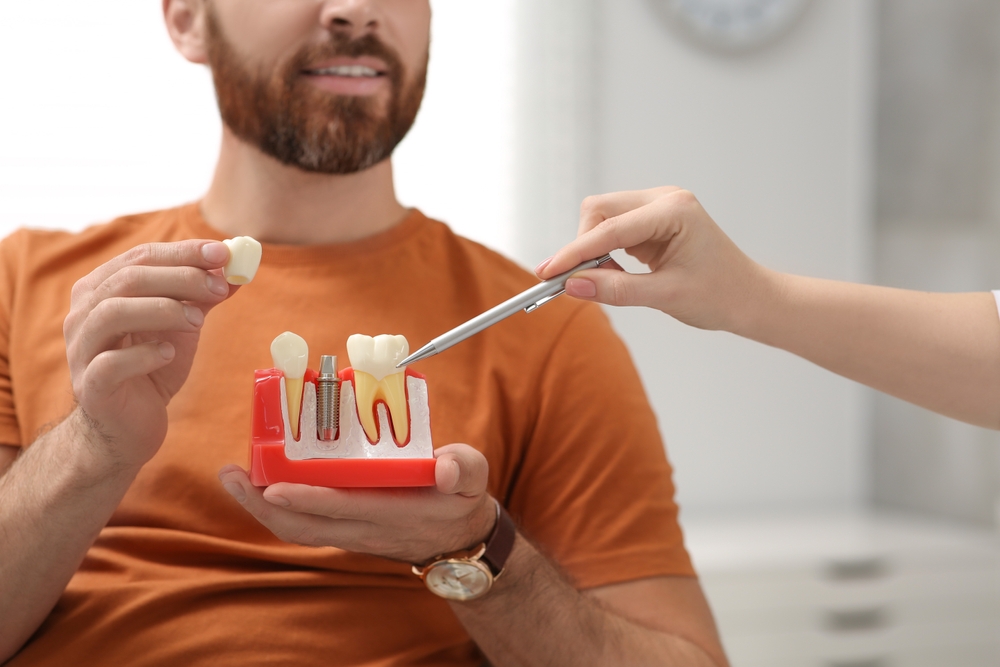
Your treatment follows four dental implant procedure steps: a post, a healing period, a connector, and a crown. We place a titanium implant post into your jawbone where the root used to be. Over the following weeks, osseointegration takes place as your bone grows around the post and holds it firmly. Once that bond is solid, we attach a small connector called an abutment, then fit a custom implant crown shaped and shaded to blend with your other teeth. In our modern operatories, we use laser dentistry to help control bleeding in the gum tissue. You’ll rest in a comfortable chair during longer appointments.
Where do Dental Implants fit into your treatment plan?
All of your implant care takes place at our single location, 4501 Mission Bay Dr Ste 2E. Expect several visits over a few months. Each stage needs healing time before the next one starts. You can begin with our $149 new patient special, which includes an exam, X-rays, and a cleaning for patients without periodontal disease. At that visit, Dr. Zaragoza goes over your X-rays with you to assess your bone levels and check your gums. If your jaw needs more bone first, a graft can rebuild the area before a post goes in. We’ll tell you early if that step calls for a referral.
When is the right time to consider Dental Implants?
The right time to replace a missing tooth is soon after you lose it, while the bone under the gap is still full. Implant healing time differs from person to person, and the post usually needs a few months to fuse before your crown goes on. Good implant maintenance, including daily brushing, flossing, and regular cleanings at our practice, keeps the gum and bone around a post healthy for years. Our Sunday hours and walk-in visits make it easier to get started, even on a packed week.
Why Dental Implants over the alternatives?
Implants replace the root as well as the tooth, and that is the main reason we recommend them when you qualify. A bridge has a real advantage, since it’s finished in a few weeks and needs no surgery. A denture costs less up front and can replace a full arch in one step. Both sit above the gums, so neither one slows the bone loss that follows an extraction. An implant asks more of you, including a surgical step and a longer wait before your new tooth is ready. The payoff shows up in long-term implant success rate research. A multicenter study followed 180 patients for a mean of 10 years and found biological complications in 9.6% of implant‐supported FDPs, far below the rate for bridges anchored to natural teeth.
Untreated Tooth Loss Accelerates Bone Deterioration and the Consequences Go Beyond Your Smile
Bone loss starts right after an extraction. A systematic review in the International Journal of Dentistry, drawing on Schropp’s extraction-site research, reports that within 12 months a 50 percent reduction of alveolar ridge width can be observed. That ridge is the strip of bone a future implant would sit in. The same review notes that most of this loss happens early, so the chance for a simple repair fades quickly. A narrower ridge offers less support to your lips and cheeks, which can make that part of your face look sunken. It can also leave too little bone for a post, which adds time and cost to your care later on.
Options
Single Tooth Implant
A single tooth implant replaces one missing tooth when the bone and gums around the gap are healthy. We place one post where the root used to be, then top it with a crown matched in shape and shade to your neighboring teeth.
Will my other teeth need work too? To hold a bridge, we have to file down the teeth on each side of the gap. An implant stands on its own and needs no alteration of healthy adjacent teeth.
Enamel filed away from a tooth never grows back.
Opposing Perspectives
Longevity is the strongest case for a single implant. A follow-up of 13 patients treated at the Brånemark Clinic in Sweden found cumulative survival rates were 95.6% for the implants after 38 to 40 years, though many original crowns needed replacing along the way.
If a crown wears out, we can replace it while the post stays in the bone.
Placement involves surgery and months of healing, which can rule it out if you need a fast fix or have a condition that slows recovery. The upfront cost also runs higher than a bridge in many cases.
Implant-Supported Dentures
When most or all teeth in an arch are gone, implant-supported dentures give a full denture something solid to hold onto. We place a small number of posts in the jaw, and the denture attaches to them. You can still take it out each night to clean it.
Does your current denture slide when you bite into a sandwich or need frequent adjustments? Each post needs the same healing period as a single implant before the denture can attach to it. Once healed, the posts hold the denture steady, and they give your jaw some of the pressure it needs to slow bone loss.
Opposing Perspectives
In a study of 40 people aged 50 to 75 without natural teeth, those with lower overdentures on two implants broke food down into a greater percentage of finely chewed particles than conventional denture wearers.
A conventional denture, by contrast, needs no surgery and takes only a few visits to make. This option still requires surgery and a healing period. If a health condition makes surgery unsafe for you, you may not qualify. It costs more up front, too.
The small attachments that hold the denture to the posts wear with use and need periodic replacement.
Full Arch Restoration
Full arch restoration replaces a whole upper or lower set of teeth with a fixed set held by a small number of implant posts. The teeth stay in your mouth day and night, and only a dentist can remove them.
This option suits someone who has lost all or nearly all teeth in an arch, or whose remaining teeth are failing. Planning takes longer than for a single implant, because imaging has to map the bone across the whole jaw. Surgery and healing also stretch over a longer timeline.
Opposing Perspectives
Complexity and cost are the main trade-offs here. Treatment runs on a long timeline and costs more than removable options, and some people need a bone graft before posts can go in.
A fixed arch can restore biting strength for someone who has lived with loose dentures. In a study that followed 10 patients for one to three years after full arch surgery using navigation, the only lost implants belonged to one patient who smoked, resulting in an implant CS rate of 95.8%. CS here means cumulative survival, the share of implants still in place over time.
Smoking slows healing, so it’s a risk to raise before this treatment.
Alternative Treatments (What happens if you do nothing?)
Financial Implications of More Invasive Solutions
A missing tooth costs the least to fix when you treat it early. Each month a gap stays open, the repair tends to grow. Every added step brings its own fee.
A case that once needed one post can later call for:
- A bone graft to rebuild the ridge
- Extra surgical visits and healing time
- Work on teeth that drifted into the gap
- A larger restoration in place of a single crown
For affordable dental implants, we offer a membership plan for patients without insurance and Cherry financing for up to 12 months with no interest.
Complete Tooth Loss Costs Billions in Lost Productivity
Tooth loss also costs money away from the dental chair.
An analysis in the Journal of Dental Research estimated worldwide productivity losses for 2019 and attributed $167.29B to edentulism, the complete loss of natural teeth. Productivity losses count the work people can’t do at full strength because of a health problem.
The estimate covers every country studied, so it shows the scale of the problem and says nothing about one person’s bill. On a personal level, missing teeth can mean time off work for pain and treatment.
Health Implications of More Invasive Solutions
Jawbone loss changes how the teeth around the gap sit and meet.
The teeth on either side lose support and start to tip into the gap, and the tooth above or below can drift toward it too. Your bite changes as they move, so teeth that once met evenly start hitting in new places.
That uneven contact can wear down enamel and put stress on the jaw joint.
Tipped teeth are also harder to clean, which leaves more room for plaque to build up along the gumline. Plaque there raises the risk of gum disease.
Older Adults With Few Teeth Rarely Meet Diet Guidelines
Diet quality drops as natural teeth disappear.
Among 635 older adults living in the community in two North Carolina counties, less than 1% of those with 0-10 teeth met the overall Healthy Eating Index recommendations. The Healthy Eating Index scores how closely a diet follows federal nutrition guidelines.
The study focused on older adults, and diet depends on many factors beyond teeth. When chewing hurts, firm foods like raw vegetables and nuts become hard to eat. Softer foods with fewer nutrients can take their place.
Safety Implications of More Invasive Solutions
Loose dentures create a real safety concern. When a poorly fitting denture shifts while you eat, food can slip back before you finish chewing and raise your risk of choking, especially as you get older.
Untreated gum disease around your remaining teeth can also make blood sugar harder to control if you have diabetes.
A broken tooth beside a gap or a cracked denture needs prompt care. Sharp edges on a cracked denture can also cut your gums and cheek. We offer emergency dental care with same-day appointments for problems like these.
Tooth Loss Is Linked to Higher Heart Disease Risk
A meta-analysis of prospective cohort studies found that each additional two teeth lost came with a 3% increment of coronary heart disease risk. The analysis found a similar rise in stroke risk.
Coronary heart disease narrows the arteries that feed the heart. The researchers drew on studies that followed large groups of adults for years. Gum disease often comes before tooth loss and keeps low-level inflammation going in the body.
The findings show a link, and they don’t prove that losing teeth causes heart disease.
FAQs
How do I find a dental implant provider near Clairemont?
Look for a licensed dentist who offers implants, explains your options clearly, and serves the Clairemont area. You’ll find Azara Dentistry a short drive away in the Mission Bay area of San Diego, and we welcome patients from Clairemont. A dentist close to home also makes follow-up visits easier to keep during healing.
To get started, call us at 858.270.6626. If you’d like to talk before coming in, you can book a telehealth visit through ZocDoc and ask your first questions from home.
Bring a list of your medications and any recent dental X-rays to your first visit, so we can see your full health picture sooner.
How do I care for dental implants after placement?
Implant maintenance looks a lot like caring for natural teeth. An implant can’t get a cavity, but the gum around it can still get inflamed from plaque buildup.
A simple daily routine covers most of it:
- Brush twice a day with a soft-bristled brush, paying attention to the gumline around the implant
- Floss or use an interdental brush around the post every day
- Keep your professional cleanings on schedule so we can remove plaque below the gumline
- Call us if the gum around the implant bleeds, swells, or feels tender
Avoid chewing ice or hard candy, which can chip the crown. If you grind your teeth at night, mention it, because grinding puts extra force on the crown.
Can I be sedated during dental implant placement?
Yes, we offer sedation dentistry for patients who feel nervous about surgery or want a calmer experience while the post goes in. Sedation for implants can help you relax through a longer appointment without tensing up.
The right level of sedation depends on your health history, your medications, and how long your procedure will take. You’ll decide on it with Dr. Zaragoza during planning, so nothing about it is a surprise on surgery day. Plan to have someone drive you home if your sedation calls for it.
Tell us about past dental experiences that made you anxious, because that history helps us choose the right level of support.
How do implant-supported dentures differ from a full arch restoration?
The biggest difference is whether you can take the teeth out. Implant-supported dentures attach to a few posts, and you remove them to clean them at home. The posts keep the denture from sliding while you eat and talk.
A full arch restoration holds a fixed set of teeth on implant posts, and only a dentist can remove it. You clean it in place, much like natural teeth, using a brush and special floss or a water flosser to reach underneath.
The better fit for you depends on your bone volume, how many teeth are missing, and how much daily upkeep you’re comfortable with.
What is the long-term success rate of dental implants?
Implants have a strong long-term track record when the patient is a good fit and keeps up with care at home. The implant success rate you can expect depends far more on your own health and habits than on the implant itself.
These factors carry the most weight:
- Bone quality and volume at the implant site
- General health, including how well you manage diabetes and other conditions that slow healing
- Daily hygiene and routine cleanings
- Any preparatory treatment, such as a bone graft, completed before placement
Some of these you can change before treatment begins. Steady blood sugar control and a better home care routine both give a new implant a healthier start.